
DATE
LOCATION
Kaye Playhouse, Hunter College
REVIEW BY
Swati Seshadri
PHOTO CREDIT
Nir Arieli
For two evenings each September, the Indo-American Arts Council’s Erasing Borders Dance Festival brings Indian dance to the New York stage. Its eighteenth edition brought together Bharatanatyam, Kuchipudi, Kathak, Mohiniyattam, Kalaripayattu, Odissi and contemporary dance, with artists based in both India and the US.
Day One
Ganesh Vasudev and Nitya Narasimhan opened with Kiraataarjuniyam, the encounter between Arjuna and Shiva over the Pasupatastra. Both are based in the Bay Area, raising another question: how actively is a New York festival seeking dancers from its immediate surroundings?
Vasudev entered as Arjuna with a strong trikala jati depicting his tapas. I particularly enjoyed that the jati wasn’t a moment when Arjuna’s predicament was put on hold because it was time to do some nritta. He had considerable stage presence and effortless jumps. There were occasional issues with balance – the ambitious side-lighting may not have helped. Balancing on one leg is difficult enough without a spotlight coming at you sideways.
The recorded music also frequently swallowed the dancers’ salangai (ankle bells): you could see the force of the footwork but not hear it. Narasimhan’s energy was evident, but her adherence to tala occasionally wavered. There were choreographic details which she executed beautifully, particularly Ganga transforming into a feather. Her movement also carried recognisable traces of her lineage through Shweta Prachande, a disciple of Priyadarsini Govind. While she established Shiva as a hunter, Vasudev sat at stage left in complete stillness without pulling focus. This sounds like faint praise until you consider how difficult it is to sit visibly on stage and convince an entire audience to forget you’re there.
Their battle created several beautiful snapshots but needed greater cohesion. A lengthy conversation establishing who was the better archer also seemed unnecessary when the actual battle underway seemed an efficient way of settling the matter. The ending, with Shiva granting Arjuna the Pasupatastra, needed more time to land. Nevertheless, this was a peppy and engaging opening.

Preeti Vasudevan’s Conversations with Cunningham & Cage, created with composer Kamala Sankaram, explored love, surprise, fear, peace and anger, drawing on the early collaborations of Merce Cunningham and John Cage. Love pulled Vasudevan repeatedly towards something she seemed to be trying to leave; surprise introduced a chair and audible gasps within the score. Very little movement happened, yet it was thoroughly engaging. Proof that holding our attention doesn’t require filling every second with movement. Anger developed convincingly through rapid repeated gestures that moved gradually from confusion to fury.

Sreelakshmy Govardhanan’s Soorpanakha asked us to reconsider whose version of a familiar story we have been accepting. It was, for me, easily the standout work of the evening.
Govardhanan’s spoken introduction reframed Soorpanakha not as caricature but as a woman forced to live with the physical consequences of violence. What right does a woman have to desire, and to make that desire known? Before she was Soorpanakha, the woman with talon-like nails, Govardhanan reminded us that she had a name: Meenakshi.
She allowed Meenakshi to be a nayika first.
Govardhanan began speaking in Telugu, drawing us immediately to her facial abhinaya. Even the following jati became part of the storytelling rather than interrupting it.
And then Meenakshi saw Rama. Govardhanan drew us into the dreamy state of someone suddenly captivated by another. Everything softened, supported by simple, effective lighting. Meenakshi prepared herself as any nayika might: with excitement, apprehension, anticipation and joy. She was just a woman getting ready to meet someone she fancied.
Hope became desperation, confusion, anger, rage, until finally came the violence that would define how she was remembered.
Govardhanan ended as she had begun: everything was stripped away until all we could hear was her breath and her voice. A powerful end to a work about a woman whose body and voice have been controlled by others.

Shila Mehta’s Nimitta, performed with Salonee Satagar and Sanchita Dighe, returned us to the Mahabharata through Amba and Shikhandi, drawing on Mehta’s research into Charani style of vocal narration, poetry and rhythm. There was a lot to appreciate: direct address, folk-inflected storytelling, Mehta’s expressive eyes and crisp dancing. The Hindi narration made the story accessible to many, but inevitably not everyone. For a festival called Erasing Borders, what happens when a storytelling tradition crosses a geographical border but its language does not?
Someone had apparently heard my complaint about the inaudible ankle bells and rectified it very enthusiastically. Meanwhile, aggressively bright colours were projected onto a white backdrop. Why? Presumably because watching the dance had until this point been far too easy on the retinas. More fundamentally, Nimitta did not flow easily for me: even knowing the broad story, I struggled to immerse myself in it, and greater cohesion between the three dancers would have helped.

Then came Radhe Jaggi, the evening’s marquee artist.
Earlier publicity had billed “Radhe Jaggi and Team” as a Bharatanatyam and Kalaripayattu group, while the final programme listed Jaggi as a soloist performing three excerpts from Bhakta. Travel complications had necessitated the change, raising a curatorial question: if a work changes substantially, should its position in the programme also change?
Across Devi, Auchitya and Alakh Niranjan, Jaggi move gracefully, but remained within a similar meditative tone. Devi unfolded against intensely cinematic music that seemed determined we should feel something huge, whether or not the movement had got there yet. Auchitya, using the imagery of lovers parting to consider Death in Ravana’s life, offered beautiful music but a constant stream of hastas that did not produce clarity. Fewer ideas, developed more deeply, might have achieved more.
By Alakh Niranjan, the absence of contrast across the three pieces became difficult to ignore. Around me, audience members shifted. Phones appeared. Whispered conversations began. Some people left. The collective restlessness was difficult to miss.
The problem wasn’t stillness, slowness or contemplation. It was the absence of contrast across an extended closing set.

Day Two
Neena Prasad and her musicians began Śivānubhavam, answering a complaint I have made about Erasing Borders before. Live music. Finally!
Prasad’s exploration of Shiva began with a Mallari-like introduction in Nattai, considering Shiva through cosmic balance: Ganga’s water, fire, the damaru and the cosmic dance.
Prasad was in no hurry. Her movement was fluid, grounded and unflashy, with no anxiety that something impressive must happen every few seconds lest we get bored. She trusted the form, the musicians and us enough to let the work speak for itself.
What I enjoyed most was watching the musicians interact with Prasad and one another, visibly enjoying the exchange, something that recorded accompaniment cannot replicate.
Prasad’s unselfconscious willingness to take time gave the work space to settle. The Shiva tandava brought it to an uninhibited end.

Radha Varadan followed with a Tarana in Raag Bhageshree and Jhap Taal, weaving the sringara of a young nayika into a format normally associated with abstract dance. Beginning seated at centre stage, she burst into infectious energy, flirting with the music. At times I wanted her facial expressions dialled down a notch; the flirtation was most convincing when it felt spontaneous.
I also wanted her to use more of the stage. Kathak offers an expansive vocabulary, yet Varadan remained drawn to the centre. Nothing, as far as I could tell, was hiding in the corners. Towards the end, the clarity of her footwork wavered. But it was undeniably a crowd-pleaser, greeted with many cheers.

Aparna Sindhoor and Anil Natyaveda’s ensemble then changed the theatrical language completely.
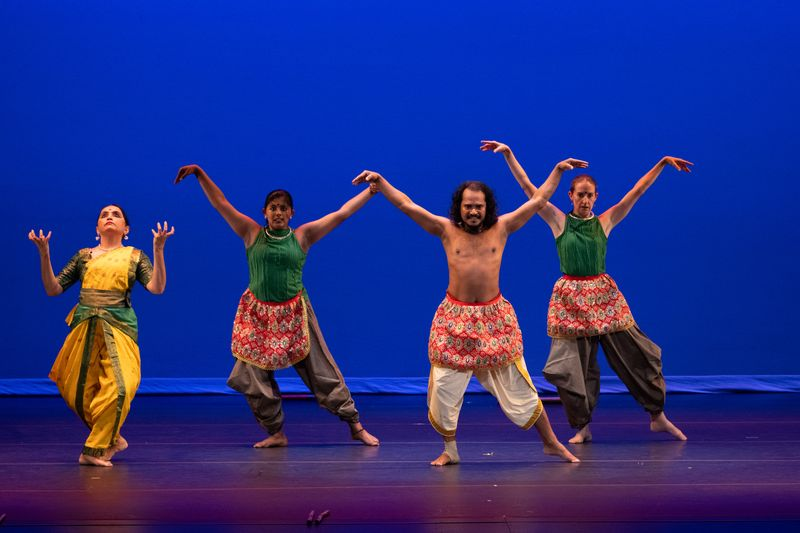
Three dancers entered, working the land. Sindhoor arrived as a travelling bard, singing folk-inflected songs and bringing news from faraway lands. English narration guided us through questions of land, conquest and colonisation. The sole white performer became the figure who arrived to conquer and colonise the land. Not subtle. But subtlety did not seem to be what this work was after.
Bharatanatyam sat alongside folk movement, physical theatre, partner and contact work and Kalaripayattu sequences. Sticks and agricultural objects became part of the theatrical world. Sindhoor herself sang, danced and spoke, and did all three convincingly. The work’s power came from the whole package: movement, hairography, athleticism, voice, objects, rawness, humour and storytelling.
And the work also brought in humour effectively. When water became scarce, we were informed that black clothes don’t really need washing. Don’t lie. We have all conducted this experiment. Elsewhere, the God of War arrived as saviour, distributing aid to people from whom resources had been taken in the first place. Humour sharpened rather than trivialised the work’s critique.
As conditions deteriorated, we were left with the declaration: “We will dance till we die.”

Arushi Mudgal and her team closed the festival with Athaah, five works of considerable range. Vocalist Sawani Mudgal sang beautifully over recorded accompaniment and occasionally played manjira, a halfway house between recorded and live music that she made work. After Neena Prasad’s full ensemble, though, it was impossible not to want a full orchestra onstage.
In Pārvatī Lāsyam, Arushi Mudgal and Shalakha Rai moved as Shiva and Parvati with such ease that the fiction became convincing. Of course they dance like this together… they’ve had millennia to rehearse. Aikya, the evening’s second Bhageshree Tarana, saw Mudgal travel rapidly and effortlessly across the stage. Apparently the corners were safe after all.
Chhaliya, a playful exchange between the gopis and Krishna, was particularly effective. Mudgal and Rai were two people conversing – interrupting and reinforcing each other, sometimes speaking independently and sometimes as one. Raam Haun then moved to Kaushalya confronting Rama’s exile before Aahlad returned us to joyful abstract dance.
The five works followed one another rapidly, leaving little time to remain within one emotional world before being transported into another. We were certainly never bored. We weren’t always given enough time to feel, either. One fewer piece might have allowed the audience to absorb what we had just experienced.

Good abhinaya relies on a conspiracy between performer and audience.
We know we are watching a dancer perform rehearsed choreography, but for a few minutes we agree to believe otherwise. Move too quickly into another musical cue, story and emotional universe, and we are reminded of the machinery. The spell breaks before we’re ready to let it go.
The audience’s attention is fragile. Across the festival, sound too quiet and then too loud, competing lighting and mid-performance seating sometimes got in its way.
This matters because so much dance now reaches us through screens. A Reel can show us a crisp turn. A Short can preserve beautiful abhinaya. A photograph can capture an extraordinary line. But none can reproduce what happens when a dancer is physically in front of us and asks us to properly look.
That is an increasingly unusual request. No second screen. No scrolling after thirty seconds. No spectacular jati extracted from everything before and after it.
Sure, I still want more adventurous programming and greater attention to production from Erasing Borders. But for two nights in New York, the festival asks us to stop doing everything else and watch.
We know the artist in front of us is a dancer. And yet they are Shiva, Meenkashi, Kaushalya. We know it isn’t true but we agree to believe it anyway. You can’t scroll your way into that.
Swati Seshadri is a Bharatanatyam dancer and Carnatic vocalist. She is the Founder and Editor of Line & Verse. Her work across performance, teaching and writing is grounded in a deep engagement with classical practice, musicality and the evolving place of South Asian arts in contemporary cultural life.

Leave a Reply