
DATE
LOCATION
Bharatiya Vidya Bhavan, Manhattan, New York
REVIEW BY
Kushal Sahabir
PHOTO CREDIT
Sushant Khire, John Burns
To present a jugalbandi concert as young musicians is a courageous endeavor, solely because it is something unlike what you’ve prepared for in your training. Jugalbandi concerts refer to one where two musicians that train as soloists come together as a duet and present different styles and lineages as one. To present a Hindustani-Carnatic jugalbandi is then a tremendous risk for musicians of 2 different traditions to share different ideas and create unity out of it. I, for one, am glad these musicians took the leap at the Bharatiya Vidya Bhavan, a haven for the Indian classical arts in New York City.
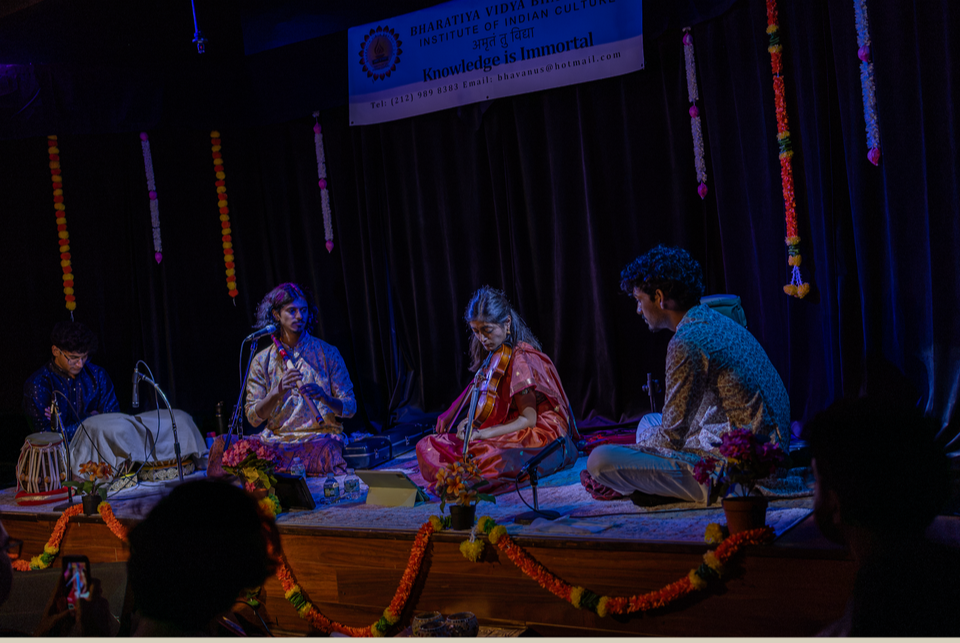
On this occasion, the melodic presentation came from two instrumentalists, Pranav Shikarpur on Hindustani bansuri and Tanisha Srivatsa on Carnatic violin and were accompanied by Neil Khare on tabla and Siddharth Ragavan on mridangam. These four, although students of great masters and upcoming stars of the New York Indian classical scene, endeavored to present a format that is uncommon for many reasons, yet they showed the willingness to present each other’s sound authentically while being open to confluence.
“… they showed the willingness to present each other’s sound authentically while being open to confluence.”
The Hindustani-Carnatic jugalbandi also takes many forms because of the lack of a set structure, but it typically includes one main item in a raag that is similar in both traditions and then a few smaller pieces, again, in similar raags. On this particular occasion, they chose to present 2 medium length pieces to showcase the full range of both traditions and allow each instrumentalist to show the fruits of their practice. They started the evening with raag Rageshree, an evening-time raag in Hindustani music that shares similarities with raag Ravichandrika in Carnatic music. The time cycle chosen was that of 7 beats, Rupak taal/Misra Chapu talam, for Hindustani and Carnatic traditions accordingly.

As Pranav started his alaap, you could sense the mood in the room shift and become attuned to the music. As he and Tanisha traded phrases, showing off the differences in the traditions’ approach to alaap as well as the differences in their instruments’ tonality, they came together to build tension and subsequently resolve it. They then played an interesting composition which started on the 5.5 beat of the 7 beat time cycle, keeping the percussionists on their toes as well as showing off some of the taans (improvised lines that adhere to the raag which usually are fast) and tihayees (equivalent to theermanams) that land on the 5.5 beat. They also explored an idea of triplets in 7 which showed off the technical mastery of rhythm by all the musicians involved. It’s well worth noting the synergy between the 2 percussionists as they traded turns accompanying and picking up on each other as they finished their phrasing. They were able to tastefully add to the performance while showcasing their restraint in not taking away from Pranav nor Tanisha, a desirable quality displayed by two talented percussionists.

After this presentation, we were then treated to raag Vachaspati, a predominantly Carnatic ragam which has also been incorporated into Hindustani music, with a kriti in desh-adi talam, Paratpara Parameshwara. Tanisha introduced the ragam in the alapana, utilizing the beautiful expressiveness of her instrument, and Pranav picked up soon after, matching her phrase for phrase. After several rounds, they transitioned to a tanam section, showing off the dynamism of their instruments as well as the enhancement of the raag-bhav in rhythm.

The kriti, a popular one within Carnatic circles, is set to a tricky talam which was handled aptly by all musicians on stage. Seeing the engaged audience keep the clap in unity was also a pleasant experience and also helped the musicians! After some beautiful trading of phrases and complex phrases to highlight the offbeat nature of the talam, they then progressed into a tani avartanam. Neil took the first turn and explored the 8-beat time cycle with an exploration of the tabla’s soundscape and then showcased his technical versatility through some traditional tabla compositions. Siddharth then took the time to show his capability as a soloist with some fiery phrases and clever calculations, ending with mohra and korvai which Neil joined in for to end the tani.

They then ended the concert with 2 short pieces, a bhajan ‘Jagadodharana’ in raag Kaapi/Pilu, and a thillana in Kadanakuthuhalam. Both pieces were succinct and felt well prepared, with a number of interactions that suited their pieces’ moods, like the slow, meditative taans in Jagadodharana and the upbeat, precise runs in the thillana. The thillana was a personal favorite, given the fresh and uplifting mood of the ragam, and was a perfect ending to the concert, like a dessert at the end of a big meal.
Overall, the quartet had a well thought-out set that was well executed, especially for a group of working professionals and students, and carried pieces from both traditions that were presented traditionally as well as adapted into fresher contexts. I really enjoyed the interactions with the audience, with Pranav and Tanisha introducing the pieces and their relevance to the traditions as well as informing the audience to specific details to better understand the music presented. Although I felt the pieces were well presented, I would’ve wanted to hear more of Tanisha and Neil as the 4 of them played together, but this was definitely limited due to sound issues which overall left them sounding washed-out, compared to Pranav and Siddharth. I enjoyed Neil’s dual use of both low-pitched and high-pitched tablas, and even though he switched between the two in different situations, I would’ve liked to hear more of the high-pitched one to differentiate from Siddharth’s treble and give the tabla more of a distinct voice.
As a jugalbandi format which is not often presented in New York, I really give props to all 4 members of this group for attempting to present their take on Hindustani-Carnatic jugalbandis. It is much easier to stick within your respective traditions and play what is familiar to you, but the results of their bravery have not gone unnoticed. Seeing a crowd at the Bhavan that was close to full, with a huge youth showing, shows that this is music that people will listen to when fresh takes are presented.
Kushal Sahabir is a tabla player, born and raised in Queens, New York. Having studied under a variety of masters from different schools of tabla, he continues to learn and perform in a classical context as well as seek to further the role of tabla in new contexts.

Leave a Reply