
DATE
LOCATION
Gibney Studios, NYC
REVIEW BY
Dhruva Lakshminarayanan
PHOTO CREDIT
Grace Copeland
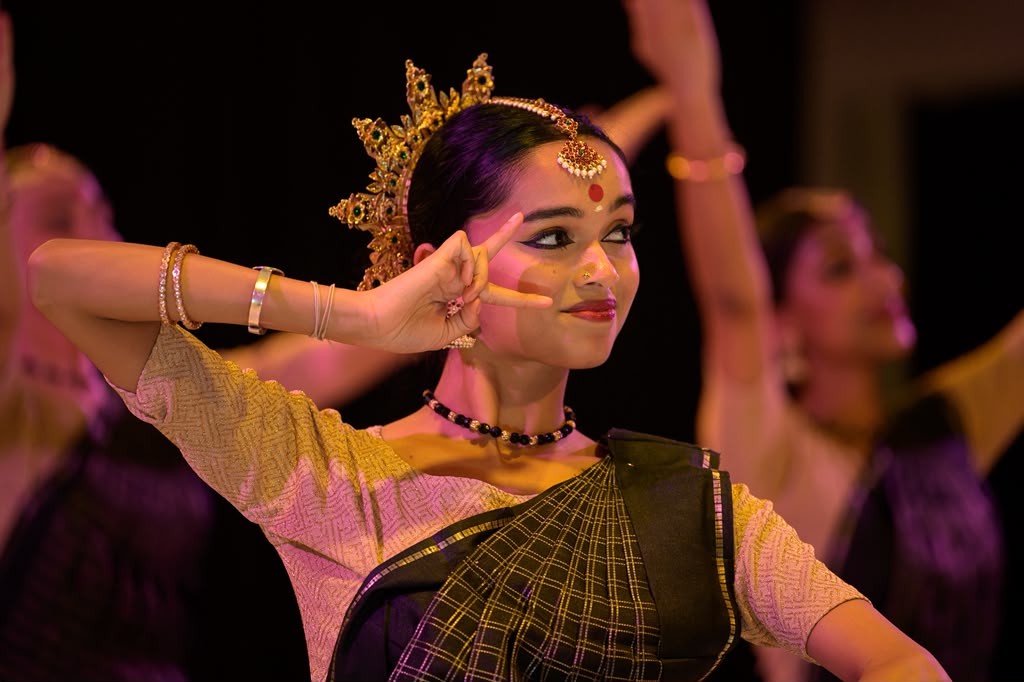
After a long day’s work on a Thursday evening, I walked into Gibney Studios in Lower Manhattan to witness Dashamahavidya, a dance theatre production by Silambam Phoenix, helmed by Srimathi Mohan.
A very short introduction later, Vaibu Mohan, writer of the piece, emerged in the role of the bhakta- the devotee, wielding an imaginary bell and Aarti. The stage was set and the piece officially commenced. The premise centered on the bhakta, who despite spending hours on various rituals and rites, and cooking for and decking her deity, somehow felt unfulfilled; that there was something missing, that she had never felt heard by the deity she venerates. To try and make sense of, and to overcome, this vacuum, she sets off on an arduous journey. What ensued were depictions of her divine encounters through the length of her peregrination, where her calls are finally responded to. One by one, the story wove in each of the 10 Mahavidyas, each representing a particular quality of the supreme mother, and teaching the Bhakta a valuable lesson each time.
The audience was informed post-show that the dancers rehearsed together for about 10 days before presenting the piece, which was shocking as the condensed timeline did not come through at all. The choreography involved intense formations and synchronous footwork, as well as multiple simultaneous entries and exits. This was also coupled with the newly introduced theatrical aspect with none of the dancers being from a theatre background. All of this was managed successfully, which would only be possible with rigorous practice, sometimes not even visible in other productions that have had years to practice and perfect. So kudos to the team for pulling it off.

The costumes had a moment of their own, the subtle black and gold suited the intimate black box setting very well, and the addition of the colored pallu and the crown to signify who the Devi was in each instance was a stunning touch, with a slight nod to the Kalakshetra tradition of the dancer depicting the deity to be adorned in a flower garland and invoked on stage with two other dancers holding a bright, bedazzled silk cloth.
Going into the performance, I was curious to see how the piece, which had been conceived originally as a dance performance, would be reimagined as a theatrical production. And more importantly, how spoken word would augment the Abhinaya instead of merely mimicking it. There were some elements that were interesting, such as one person on stage with a collar mic speaking live, and the other emoting mute while their voice came from a faceless entity backstage, creating a nice contrast. I also thought the conclusion, where Srimathy Mohan and Vaibu Mohan recited verses in praise of the Goddess out loud, was extremely effective as a theatrical device, more of which peppered throughout the show would definitely have been welcomed and appreciated. For the most part however, the words used just explained the gestures literally (padartha), making it seem similar to the task of a sign language interpreter usually shoved to the bottom right of the screen on a news channel. What might have been interesting is to see Abhinaya being used in unexpected ways, either by creating varied snippets on stage simultaneously showing multiple scenarios, or by integrating the speech as part of the music, that the dancers interpretively dance to.

The format of the production was quite predictable, which was basically “bhakta chances upon deity with conundrum in mind- Deity grants boon which doesn’t go as planned- Bhakta goes back to Deity- Deity mentions something profound and in turn teaches Bhakta a lesson”. While attempts were made to break the monotony through differently paced jathis (rhythmic pieces), unexpected ragas, or even pieces in varied languages, it was at times a little tedious to go back to the same format over and over again. Another aspect I noticed was that most of the music, save for the folk elements: the hair raising Bengali Dhunuchi Nach to mimic the wrath of Goddess Kali and the super catchy Tamil Kollattam to appease Muthumari Amman, were all of a similar tempo, further leading to the monotonous character of the production. I understand that the music needs to gel with the mood being set, and that less energetic pieces might be needed to make the spoken word more effective, and honestly for the lines to even be delivered without panting, but some more well interspersed peppy numbers by non speaking dancers, adding faster beats to the same raga to keep the mood constant, might help provide a sudden spark every once in a while.

Personally, I believe that the particular emotion of bhakti while emoted on stage requires a certain level of bonafide devotion from the dancer off stage as well, whatever that devotion might be towards, without which it tends to come through as disingenuous or exaggerated. In a theatre or musical production, with large sets and a larger audience, expressions might require to be more hyperbolic to be perceived effectively, but in a small black box setting, I believe the dancers could have benefited from more underplayed abhinaya, while taking the time to self reflect and understand what that emotion actually means to them and how it could be portrayed with more intent.
“…it might be nice to also reimagine what depictions of worship in dance might be for our times”
“Worship is not stagnant, it is not frozen in time and it should always be depicted in the present day context”, was something that R. K Shriramkumar, music composer of the production, mentioned after the show, which stuck with me. In an age where our fast paced lives don’t allow for elaborate veneration; where a 5 minute airpod prayer during a subway commute might have to suffice, it might be nice to also reimagine what depictions of worship in dance might be for our times. And to see how these methods differ from the ways we’re traditionally taught to depict prayer in Bharathanatyam, while keeping the intent and emotion constant. For the most part, while there were innovations visible in the music used, such as an interlude of western music to depict the Goddess Tara, the ways in which prayer, pilgrimage, interactions with the Goddess, or even depictions of the Goddess were shown remained largely traditional, despite the theatre format. It will be interesting to see how this evolves in further iterations of the production. However, whether or not the Dashamahavidyas will appear in front of us after a five minute subway commute prayer is left to be seen.
Dhruva Lakshminarayanan is a Carnatic vocalist and Bharatanatyam dancer raised in Kuwait’s Indian diaspora. His training in design shapes his approach to the classical arts, bringing a distinctive sensitivity to space, form and storytelling. Blending melody and movement, his practice is rooted in tradition while embracing contemporary perspectives.

Leave a Reply