
DATE
LOCATION
Barzakh Cafe, Brooklyn, NYC
REVIEW BY
Sanjana Chandrasekar
PHOTO CREDIT
Magendran
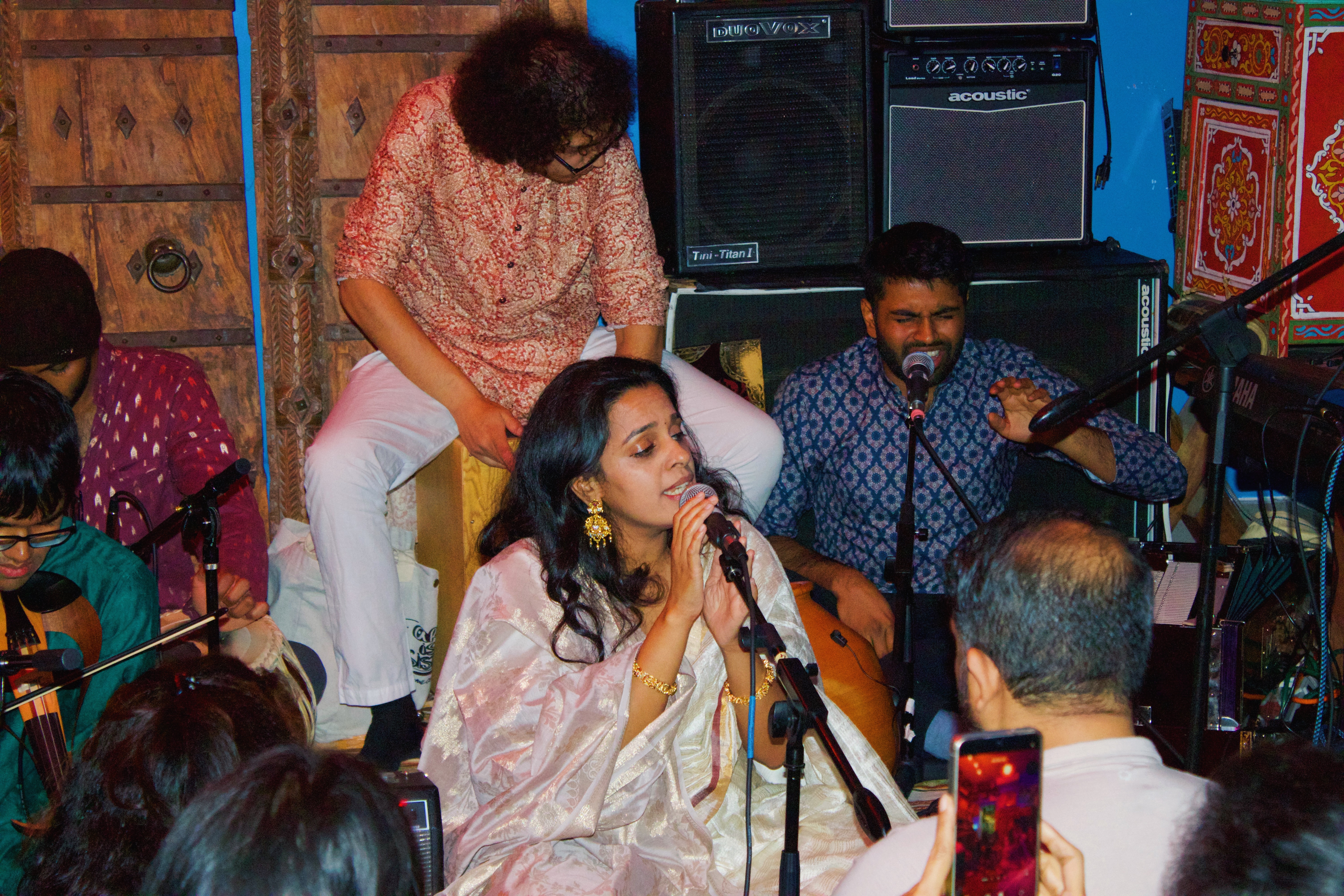
As the autumn air turns crisp, Barzakh Cafe offers a welcoming setting for live music, complete with hot chai and a rotating performance calendar. I attended Kaleidoscope, a performance by New Jersey-based ensemble Pravaah, on a packed Thursday evening. The room brought together friends, family, and newcomers, reflecting the community the ensemble is building. The setlist welcomed both seasoned music enthusiasts and first-time listeners of Indian classical music.
Pravaah describes Kaleidoscope as a celebration of South Asia’s diverse musical heritage, bringing together North and South Indian traditions in a shared musical experience. Drawing from Hindustani and Carnatic classical music, Sufi and Qawwali traditions, evergreen compositions, and Bollywood, the program explored the vastness of Indian music while also interpreting how different musical traditions connect.
The ensemble brought different musical foundations to the stage: Sweta Subramanian and Saketh Sitaram, primarily trained in Carnatic music, and Aakash Pillai, whose primary background is in Hindustani music. They were accompanied by instrumentalists Vinay Giridhar, Deshik Iyengar, Adi Pillai, and Sriraam Ramakrishnan, whose arrangements and instrumentation supported the program’s movement across styles. The evening opened with Labb Par Aaye, originally composed by Shankar-Ehsaan-Loy and sung by Javed Ali for the television series Bandish Bandits, performed by Sweta and Aakash. The arrangement remained largely faithful to the original, with minimal improvisation, offering a grounding introduction to the evening before the ensemble ventured into more adventurous reinterpretations of audience favorites.
One of the evening’s intriguing moments brought forward a unique rendition of Kamli, composed by Pritam from Dhoom 3 and originally presented by Shilpa Rao for MTV Unplugged. This was the first time I heard this version of the song performed live, offering a stripped down version of the well known Bollywood number, and additional lyrics more fitting for the arrangement and instrumentation. Aakash’s Sufi-influenced vocal passages added another dimension to the medley, particularly through his expressive ornamentation and improvisational phrasing. There is an unmistakable soulfulness to his singing, a quality that lends even familiar compositions a sense of emotional depth. His delivery brought a devotional intensity to the performance that resonated across the room.
Beyond the individual compositions, what I particularly appreciated was the intention behind the repertoire. The show was divided into six sub-themes: The Arrival, Stillness, Reawakening, Devotion, Ecstasy, and Celebration. Throughout the evening, members of the ensemble took time to explain the Kaleidoscope concept, and through which lenses the songs were being presented and the reasoning behind particular song pairings, and how each selection contributed to the show’s larger premise. Sweta had explanations that leaned more devotion forward, with pieces like Ramanai Bhajithaal and Aap Ki Nazron Ne Samjha that even when songs are not rooted in religious contexts, each song she sings connects to her very spiritually; she sings to bring light to her own life and to the audience’s life. Alternatively, Saketh would describe his pieces more emotionally, exploring themes of love, happiness, and empathy, and emphasizing the importance of allowing music to evoke those feelings within ourselves and to also share them with others. This context offered audiences an opportunity to engage with the arrangements beyond their own interpretations and to learn the artist’s own journey with compositions we all commonly know and love.

Sweta’s rendition of Ramanai Bhajithaal, set in the ragam Maand, offered a centered and divine moment. Maand is a personal favorite ragam of mine and I couldn’t help but draw an interpretation to what this ragam means for this particular presentation. The ragam originated in Rajasthani Folk Music and is now a prominent ragam across Carnatic and Hindustani music, making it fitting to the idea of the show as a whole. Sweta opens with a vrittam, an improvisational piece of devotional poetry. The vrittam, Naadiya Porul Kaikoodum, essentially touches on the two syllables in Lord Rama’s name that will bring good, prosperity, health, and wisdom, while destroying evil, sin, and suffering. Her measured delivery brought a moment of stillness and spirituality to the intimate setting and a much needed reminder of devotion, light, and positivity.
Maand remained the central ragam of the night, almost like the main in a Carnatic concert, as Saketh introduced the Thillana, carrying the ragam into the next piece. Vinay delivered a technically striking guitar solo, exploring shifts in tonal center from G (5 kattai) through different ragams before returning to Maand in C (1 kattai). The passage loosely evoked Grahabhedam, the Carnatic concept of shifting a ragam’s tonal center to reveal new melodic frameworks. The transitions were fluid enough that the underlying complexity never became a distraction. Rather than presenting the solo and showcasing technical prowess, Vinay made the changes feel intuitive, preserving the melodic character of the ragam and keeping the overall idea and making it accessible and a delightful listen across all audiences.
While there were some smooth transitions, there were also many moments where transitions felt a bit more scattered, and I would’ve loved to see greater continuity between pieces throughout the show. There were a few brief moments where instrumental changes were less organized, leading to longer pauses between pieces leading the musicians to vamping to keep the audience engaged. The show also presented an intermission which led to somewhat of an abrupt division to the show. Given the intimate format of the show, I felt that an intermission will only break the momentum and maintaining it can present a more cohesive experience. A little more rehearsal of transitions, mindfulness of the space, and tech changes could be better rehearsed and more fluid and allowed the audience to stay immersed in the show throughout.
Another particularly adventurous moment and perhaps my biggest highlight from the night came with Saketh’s rendition of Thanga Sela, originally composed by Santhosh Narayanan and sung by Shankar Mahadevan, Pradeep Kumar, and Ananthu, for the film Kaala. I personally feel that this song is an underrated one in general, so it was an immense pleasure to see this not only presented but joyfully so on stage. Saketh’s voice carried the rustic twang the song demands, capturing the infectious joy of the Tamil Gaana genre. Aakash Pillai’s harmonium and vocal contributions introduced subtle Qawwali flourishes, as well as Deshik Iyengar and Adi Pillai’s percussions adding an elevated feel to the rendition.
The instrumentalists were equally central to the evening’s musical dialogue. Percussionists Adi Pillai and Deshik Iyengar moved between tabla, cajón, ghatam, and darbuka, adapting their instrumentation to the shifting styles of the set. The use of tabla in a Carnatic composition or ghatam in a Sufi/Qawwali piece reflected the ensemble’s larger premise: instruments, like musical traditions, need not be confined to a single framework. This exchange was particularly evident in their rendition of Naal Nachna, composed by Shashwat Sachdev for Dhurandhar. Translating a predominantly electronic and sampled composition’s club-like energy into an acoustic arrangement, the percussionists recreated its driving momentum through live instrumentation, bringing the atmosphere of a dance floor into Barzakh’s intimate setting.
“…instruments, like musical traditions, need not be confined to a single framework.”
On violin, Sriraam Ramakrishnan introduced an alapana in Yamuna Kalyani ahead of Sweta’s rendition of the kriti Tunga Teera Virajam, beautifully capturing the lakshanas of the ragam. My biggest qualm was not hearing more of Sriraam, because his accompaniment added a lot of brightness to the pieces presented, and though the concert did not adhere to a traditional Carnatic-style setup, I wish I got to see more of that aspect presented and see him have more room to express his interpretations and see him spotlighted more.
More broadly, I would’ve loved to hear more solos from the percussionists. I did feel that this show was vocalist forward, and with incredible instrumentalists as part of this collective, I would’ve been intrigued to see a fully instrumental piece that spotlights each of their instruments. The show had two extremely talented percussionists, hopping across different styles. I think offering a rhythmic exploration component to the show would have been incredibly interesting, expanding on the “kaleidoscope” theme to the different percussive elements across South Asian styles of music.

The set closed with Kajra Re, composed by Shankar-Ehsaan-Loy and originally sung by Alisha Chinai, Shankar Mahadevan, and Javed Ali. A familiar closing number at South Asian gatherings, it brought the evening back to the communal spirit that had filled the room from the beginning. Sweta encouraged the audience to clap, move, and join in, turning the performance into a shared celebration.
Ultimately, Kaleidoscope offered an exploration of the ways in which musical traditions can inform one another.
Its most compelling moments were those in which the individual musical identities of its performers came together and the lines of genre blurred as the show went on.
By placing classical, devotional, folk, and popular music within the same repertoire, Pravaah created space for different generations and levels of musical familiarity to share an experience. I look forward to seeing how the ensemble continues to develop this musical exchange and the community it is building around it.
Sanjana Chandrasekar is a Jersey City-based artist manager, musician, and freelance writer who graduated from Berklee College of Music in 2025. She previously served as a staff writer for the Berklee Music Business Journal and is currently the co-editor-in-chief of The Redline, an independent music industry publication. A trained Carnatic and R&B vocalist, her interests lie at the intersection of music, culture, and the business of the creative industries.

Leave a Reply