
DATE
LOCATION
New York Live Arts, New York City
BY
Ankita Siraswar
PHOTO CREDIT
Steven Pisano, Marcus Lewis
Across solos, duets, and large ensemble works on day three of the New York Kathak Festival, what stayed with me most was the way tradition was treated as living, carried forward through memory, mentorship, rhythm, and individual imagination.
1. Bhargavi Sardesai | Shiva Vandana – Dhrupad
Choreographed by Pandita Shama Bhate
The opening performance explored the divine and cosmic presence of Lord Shiva through kathak movement, expression, and rhythm, inspired by the Shiva Tandava Stotram and the image of Nataraja. My favorite moment was the portrayal of the abhishek performed upon the Shivling. The image of water slowly dripping from a vessel suspended above the Shivling was choreographed with remarkable detail.
Throughout the performance, Sardesai’s expressions carried devotion, while her powerful and clearly articulated footwork added intensity to the piece. At moments, the resonance of her ghungroos felt almost like the rhythmic sound of Shiva’s damaru, reinforcing the connection between movement and music

2. Sukriti Sharma | Antar
Antar explored teental (a foundational 16-beat rhythmic cycle in Hindustani classical music) as an evolving experience of time. Beginning in vilambit laya (slow tempo) and gradually progressing toward drut (fast), the choreography allowed the rhythm to develop from a place of restraint into greater speed and energy.
Overall, I found the performance gentle, composed, and strongly focused on kathak technique. One movement pattern that stood out to me was the use of “ta-tai, ta-ta-tai” while travelling toward the corners and then shifting direction. The clarity of the directional changes made the rhythmic and spatial pattern very easy to observe. I also enjoyed watching the different variations of tatkar presented, highlighting Sharma’s precision, and understanding of rhythm.
Toward the end, the choreography introduced different types of kathak walks. This was an especially interesting choice, as it brought attention to the expressive potential within even the transitional movements of the form. The walks were thoughtfully incorporated into the composition and made the conclusion of the performance particularly memorable.
3. Smita Alves & Bhakti Bhav Dance | Las Palmas
Las Palmas offered a fresh and engaging exploration of the shared rhythmic and movement qualities of kathak and flamenco. Rather than directly combining the two dance forms, the choreography remained rooted in kathak while drawing attention to the similarities between their footwork, turns, clapping patterns, musicality, and expressive energy.
The music felt as though both cultures were in conversation with one another, while still maintaining their individual identities. The rhythmic interaction between the two traditions created a playful and vibrant atmosphere throughout the piece. The dancers performed with excellent coordination.
I particularly enjoyed how familiar flamenco elements were reimagined through the vocabulary of kathak. For example, movements that might traditionally be performed with a flamenco shawl were adapted using the dupatta. The costumes contributed strongly to the visual impact of the work. The white outfits paired with red dupattas maintained the elegance of a kathak costume, while the small red roses served a subtle nod to Flamenco. The color palette tied the two traditions together without making the presentation feel overly literal.

4. Anita & Sreeja | Dhamaar
Choreography and music curation by Shri Sandip Mallick ji
Dhamaar explored Veer Rasa – the emotions of courage and resilience – through compositions set within the powerful fourteen-beat cycle of Dhamaar taal. The performance moved fluidly between pure dance, rhythmic interaction, solo passages, and moments of storytelling.
One of the most refreshing choreographic choices was the extensive use of diagonals across the stage, as well as the placement of the two dancers across from each other. The dancers frequently faced one another from diagonal positions, which is not something I often see in more traditional kathak choreography. Although there were only two dancers onstage, they used the entire performance space very effectively. Their pathways, formations, and transitions allowed the stage to feel full. The choreography never appeared visually limited by the small number of performers.
The program identified Veer Rasa as the central emotion of the work and the force and intensity of the dancers’ footwork projected that quality. I especially enjoyed the recurring interactions between the dancers. Even when one dancer moved into a solo section, their connection never seemed to disappear. Their gestures, glances, shared directions, and rhythmic exchanges created an ongoing motif of partnership, making it feel as though they were continuously dancing with and responding to one another.
The concluding section was particularly exciting. The dancers gradually increased their speed and energy, ending with a sequence of 21 chakkars (spins).
The lighting was also thoughtfully designed, reflecting and enhancing the purple tones of their costumes and contributing beautifully to the overall visual atmosphere.
5. Shivani Joshi | Chaturang
Choreography by Pandit Rajendra Kumar Gangani
Chaturang was one of the pieces that also focused on the storytelling, or abhinaya, aspects of kathak. The composition moved through the four elements of sahitya, sargam, tarana, and trivat (poetry, melody, rhythmic syllables, and intricate movement respectively) within the late afternoon mood of Raga Bhimpalasi and the twelve-beat cycle of chautaal.
The performance was strongly driven by footwork, which is a striking and recognizable quality of Pandit Rajendra Kumar Gangani’s choreographic style. The rhythmic passages were intricately designed and technically demanding.
One recurring movement choice that stood out to me in this performance, as well as in several other pieces throughout the festival, was the frequent use of movements that descended toward the floor or onto the knees. It was refreshing to see this wider use of levels within a kathak performance, and it added visual variety to the choreography.
I particularly enjoyed the section in which the descending sargam “Sa, Ni, Dha, Pa, Ma, Ga, Re, Sa” was repeated three times and interpreted through footwork. The relationship between the musical notes and the rhythmic articulation of the feet made this passage especially engaging.
The ending was also memorable. The performance appeared to have concluded, and the audience began applauding. However, the dancer remained completely still under the spotlight, holding her final position for several more seconds. For a moment, it seemed as though Joshi might begin dancing again, but the sustained pause itself became the conclusion. This unexpected stillness created a sense of suspense and emphasized the final sam (the first anchoring beat of a rhythmic cycle).

6. Prashant Shah & Dancers | Let It Be
Let It Be was presented as a collection of works moving between traditional and contemporary approaches to kathak. Through this body of choreography, Prashant Shah explored the idea that change within a classical form does not necessarily require abandoning tradition.
The presentation began with a dramatic atmosphere created through theatrical lighting, haze, and a voiceover reflecting upon the nature of change. The narration questioned why change must be treated as a compulsion to become different rather than being embraced as an organic process of artistic growth. It acknowledged that dance, music, movement vocabulary, and our approaches to defining classical forms have always evolved with time.
With Me, For Me
Performed by: Prashant Shah and Riti Tandra
Concept, artistic direction, and choreography: Prashant Shah
Music arrangement: Prashant Shah
Poetry and voiceover: Riti Tandra
With Me, For Me portrayed the ongoing journey of an artist and her connection to different art forms.
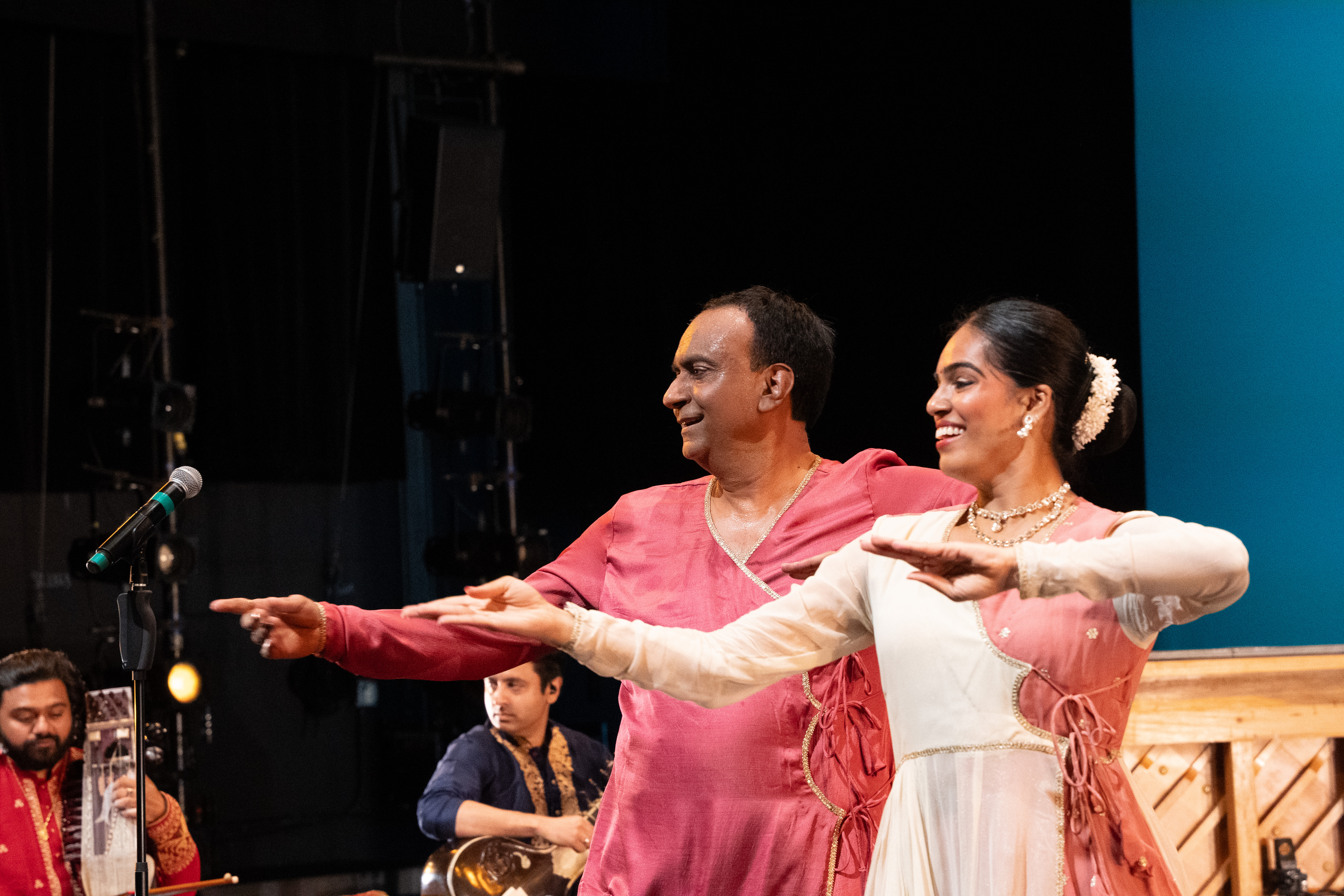
The fact that Prashant Shah and Riti Tandra are teacher and student adds another layer of meaning to With Me, For Me. Their onstage relationship is grounded in an existing process of learning and trust.
In this duet, Tandra represented the artist, while dance itself was personified by Prashant-ji. The piece began with Tandra playing a piano live under a single spotlight. This was a striking and unexpected opening.
Tandra began following Shah’s movements. On one level, it appeared to represent the familiar relationship of a student following her teacher. Within the larger metaphor of the choreography, however, it felt as though she was following dance itself.
The physical precision between the two dancers was remarkable. Their hands, lines, and angles matched so closely that it sometimes felt like watching two reflections in a mirror. Their synchronization was not merely technical; it suggested the way movement is transmitted from one body to another.
One of the most powerful rhythmic images was the sequence of thirty-two chakkars performed with rhythmic precision. Prashant-ji remained at the center while Riti travelled around him in a circular pathway, almost as though she were circling the teacher, the tradition, and dance itself.
There was also a beautiful sense of weightlessness in the choreography, suggesting that although tradition carries history, discipline, and responsibility, it does not always need to feel heavy.
Although Shah personified dance within the stated concept of the work, I also perceived his presence as representing the role of a teacher in an artist’s life. A teacher introduces the language, provides rhythm and direction, walks beside the student, and eventually understands when to step away.
The ending was subtle but emotionally powerful, completing her journey from following dance to recognizing that the dance was now truly her own.
Piya Bawri
Performed by: Aashna Shah, Ruchi Tandon, Shipra Agrawal, Priyanka Kamra, Meera Allegra, Ashwini Singh, Keyuri Mehta, and Piya Mehta
Set to the much-loved composition by Pandit Ajay Pohankar from Shri Abhijeet Pohankar’s album, the choreography was rooted in shringara rasa (sentiment of love and romance).
The overall visual and emotional world of the piece felt completely aligned with the title Piya Bawri, a state of being almost intoxicated, consumed, or driven mad by love. Eight dancers onstage, appearing almost like eight nayikas (female protagonists), sakhis (close female confidantes), or even gopis (cowherd women of Vrindavan celebrated for their devotion and love for Krishna), were each desperately longing for a glimpse of her beloved.
What stayed with me was the sense that all eight women were completely immersed in that longing. They did not simply seem to be searching for someone; they appeared lost in love, carrying that yearning through their bodies and expressions.
Tarana in Raag Gurjari
Performed by: Aashna Shah, Ruchi Tandon, Shipra Agrawal, Priyanka Kamra, Meera Allegra, Ashwini Singh, Keyuri Mehta, Piya Mehta, Janani Bhagat, Suhani Prasad, Lekha Wood, and Saara Wood
Tarana in Raag Gurjari brought twelve dancers together in a composition set to teentaal. The sheer scale of the ensemble gave this piece a very different visual energy from the works that preceded it.
What stood out to me most throughout the performance was the extraordinary precision of the ensemble. With twelve dancers occupying the stage, there was a remarkable sense of cohesion. The dancers seemed to share an almost identical understanding of where every movement began, where it travelled, and exactly where it needed to finish.
One section that particularly caught my attention divided the dancers into groups of eight and four. The eight dancers performed the iconic sequence of thirty-two chakkars, while the remaining four maintained a much slower, controlled sequence of synchronized hand gestures. I loved this contrast. Rather than having all twelve dancers demonstrate speed and virtuosity simultaneously, the choreography balanced technical intensity with restraint, allowing both qualities to become more striking.
Another refreshing choreographic moment came when the dancers gathered tightly into a cluster and then gradually opened outward. To me, the formation resembled petals closing and unfolding. It created a sense of expansion and contraction within the group and showed how effectively a large ensemble could be used not simply to fill the stage, but to continually reshape it.
Prashant Shah Live Solo
Accompanied by: Satyaprakash Mishra – tabla, Indro Roy Chowdhury – sitar, and Rohan Misra – sarangi
The much-awaited final performance of the evening was Prashant-ji’s traditional kathak solo accompanied by live music. What immediately stood out was the way he chose to begin, by first allowing each of his accompanying musicians to be heard individually.
This opening felt characteristic of Prashant-ji’s approach: creating space for the audience to recognize the artistry of the musicians sharing the stage with him first.
The solo also carried a strong sense of lineage. Prashant-ji spoke about presenting what he had inherited from guru, the late Kumudini Lakhia, affectionately remembered as Kumiben. In many ways, this became an extension of a theme that seemed to run through the evening: artists revisiting, honoring, and carrying forward the work of their teachers, mentors, and gurus.
The rhythmic exploration unfolded in teentaal. The progression of tempo revealed his command over rhythm and timing rather than speed being treated as an isolated display of virtuosity.

The padhant (spoken recitation of rhythmic syllables), became interactive. At one point, Shah invited students who had participated in his workshop to recite along with him. Their excitement was palpable. It transformed a traditional solo moment into something communal and allowed the students, even from their seats, to become participants in his performance.
The chemistry between Prashant-ji and tabla artist Satyaprakash Mishra was especially compelling. Their exchanges felt less like accompaniment and more like an ongoing conversation. Each seemed to anticipate the other, creating the spontaneity and excitement that makes live kathak so thrilling to experience.
Even within his own solo, Prashant-ji continued the gesture that had been so evident throughout Let It Be: allowing his students to come forward. Two of his senior students, Aashna Shah and Ruchi Tandon, joined him briefly during sections of the performance. That generosity felt particularly meaningful after watching With Me, For Me, where the idea of a teacher guiding and eventually allowing the student to stand independently had already been so beautifully explored.
As the concluding performance, the solo felt like much more than a demonstration of Shah’s command over kathak. It brought together live musical dialogue, choreographic memory, lineage, and mentorship. It showed tradition as something continually passed from one artist to another – my key takeaway from the evening.
Ankita Siraswar is a dancer, educator, choreographer, and co-founder of RASA Collab (an arts initiative dedicated to creating platforms for Indian classical and contemporary artists). Based in New York/New Jersey, she works across performance, pedagogy, and arts programming while pursuing an MFA in Dance at Montclair State University.

Leave a Reply