
DATE
LOCATION
New York Society for Ethical Culture, Adler Hall
REVIEW BY
Shiva Kannan
The first time I heard about L Shankar was when my friend showed me the song Darlene during our undergrad. It was from a record produced by Frank Zappa, released in 1979. I had heard nothing like it before. The production, virtuosity and the songwriting was so fresh, it immediately stuck with me. So when I was asked to write about an L Shankar concert hosted by the World Music Institute, I jumped on it right away since it was also my first time getting to see L Shankar live!
On the day of the concert, as I was getting off at Lincoln Center and rushing to read as much as I can about the artists, I was thinking about what am I here to write about really? The performance or the legacy? It was hard to balance that fanboy in me with someone who is just curious to check out an electric violin carnatic concert.


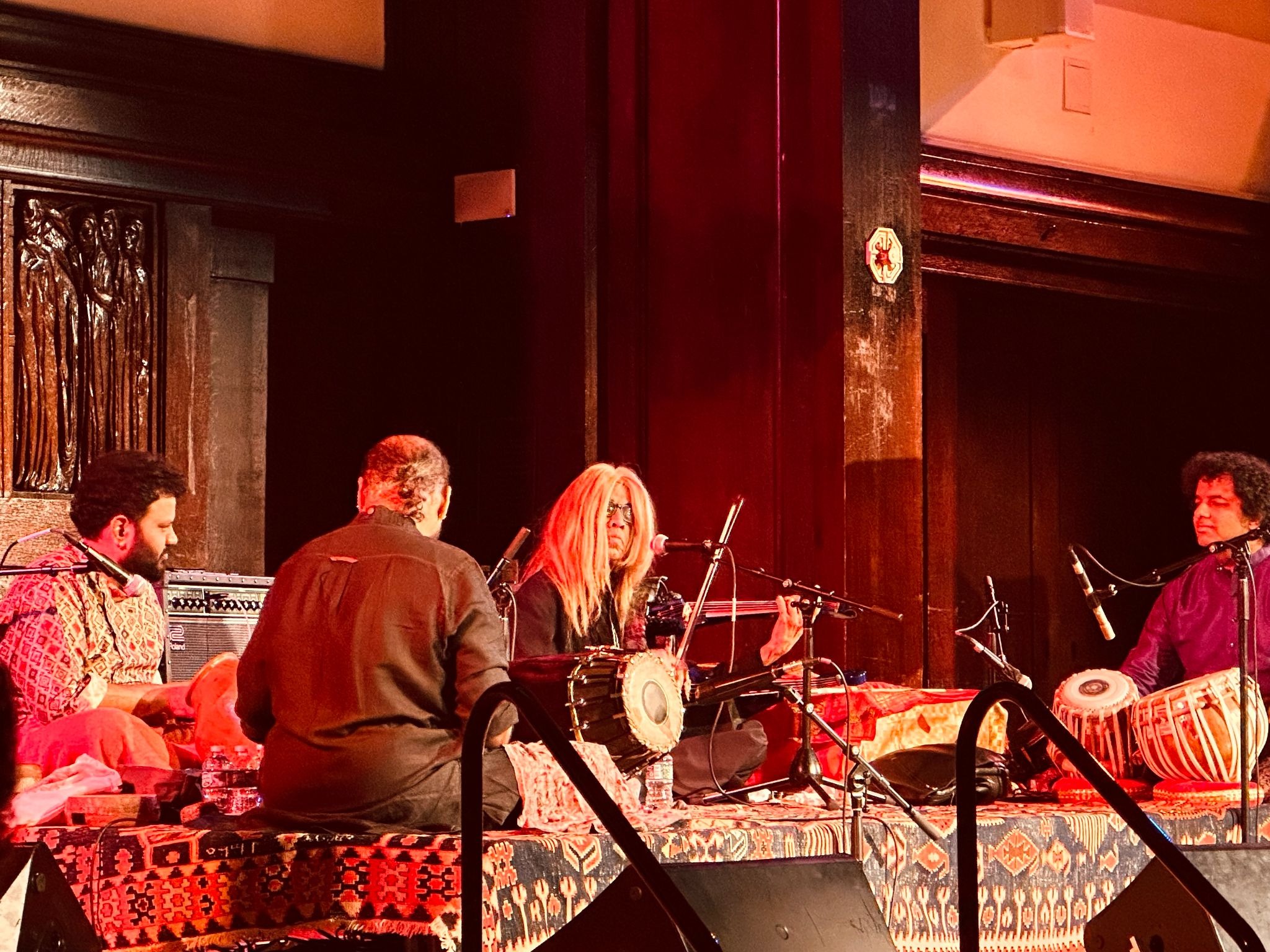
As I made my way through this beautiful venue I noticed the iconic L Shankar Double Neck Violin (more on that later) placed under the red velvet cloth in front of these two big Roland amps (for context, Roland amps are what we see at rock concerts, not at a carnatic kutcheri). I sat down, and right away, all the artists: L Shankar with Swaminathan Selvaganesh, Selvaganesh Vinayakram and Amit Kavthekar walked out to a huge roar from the audience and took the stage.
The quartet opened the concert with a fast paced composition in raagam Nagaswarali, immediately showing off the 5 octave range of the instrument during the aalapanai (improvisation of the raaga/ scale that the song is set to before the actual composition starts). It turned out to be the perfect way to get the crowd energized and make them ready for what came next.
Set in raagam Shanmukapriya, L Shankar announced the next song. It started with a hauntingly beautiful aalapanai followed by one of his own compositions. The piece had everything, from the complexity of the composition itself to all the improvisation that the quartet did throughout the piece. Throughout, I kept coming back to the sound of the instrument itself, LSD, L Shankar Double Neck Violin.
The double neck, designed by L Shankar himself, is so unique and opens up so many new sonic possibilities.
The second neck strings almost act like “sympathetic” strings when not played on (like those in Veena and Sitar), adding new textures that typical carnatic music is not used to. He also was palm-muting and playing some of the strings like a guitarist. So cool!
The piece that followed was a typical carnatic concert pinnacle – the RTP: Raagam, Taanam, Pallavi set in raagam Abheri. During the aalapanai L Shankar said: “Close your eyes, it will all make sense” as they explored the raagam for a solid 5 minutes. What followed was the taanam, an improvisational structure that sits right in between a free flowing aalapanai and rhythmic swaram – and L Shankar’s Abheri taanam stood a class apart, again because of the possibilities of the instrument and his musicianship.
An RTP structure tests not just the musicians’s compositional and improvisation skill but also how tight the group are when they play as a unit and boy were they tight!
As the RTP came to an end, Selvaganesh picked up the mic and the moment he said the word Shakti, there was a huge roar from the crowd. Oh did I mention L Shankar was one of the founding members of the iconic supergroup Shakti and that it was formed in New York City? Of course it was pretty fitting for them to pick a Shakti piece, Get Down and Shruti, to finish the concert with. Outside of the craziness that the composition itself is, in an obscure 9 ½ beat cycle, what followed was an incredible percussion solo by all the 3 percussionists. This was their time to shine. Amit Kavtekar showed off his virtuosity on the tabla and then Selvaganesh and his son, Swaminathan ended the percussion solo with an electric kanjira duo that had a mix of improvisational and compositional elements to the solo itself. Such a thoughtful structure for a percussion solo.
A high energy end to the whole concert landed them a standing ovation that lasted for minutes.
L Shankar introduced everyone on stage and gave a special mention to Swaminathan Selvaganesh, the third generation of percussionists whose father, Selvaganesh Vinayakaram and grandfather, Vikku Vinayakaram have all accompanied L Shankar. Swaminathan definitely has big shoes to fill but his skill of playing both the ghatam and kanjira and switching between them effortlessly was incredible to witness.
If I had to pick on anything for the show, it was the sounds. I sat on stage right and sometimes when all the 4 were playing high energy pieces, the sounds were washed out because of the reverb in the space, which wasn’t a pleasant listening experience.
Anyways, this review turned out to be more of a fanboy moment for me to write an ode to the legend that is L Shankar than anything else.
“These kinds of concerts and artists challenge you to open your mind up about sounds you associate with genres, the mental structures you have in mind for how Carnatic music should be, what an instrument can and cannot do.”
But these kinds of concerts and artists challenge you to open your mind up about sounds you associate with genres, the mental structures you have in mind for how carnatic music should be, what an instrument can and cannot do but when was the last time you saw a tabla, ghatam, kanjira and mridangam try to keep up with a double-neck violin blasting through two Roland amps on stage? Iconic!


Leave a Reply