
DATE
LOCATION
Peridance Center, NYC
REVIEW BY
Sneha Subramaniam
PHOTO CREDIT
Pamela Tetteh
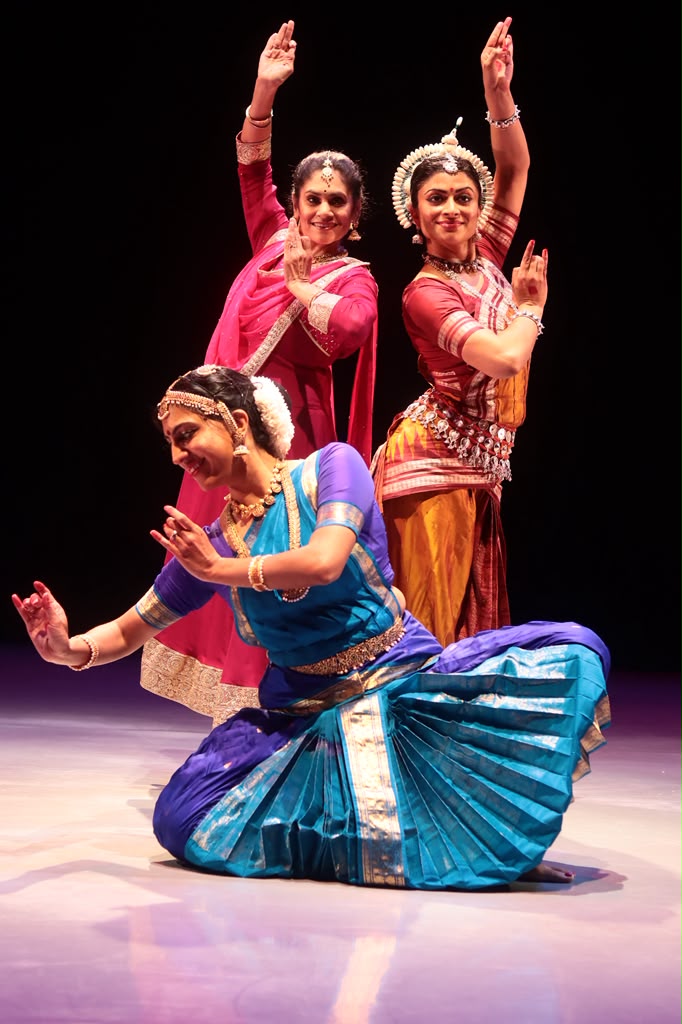
Pravaha: Flowing Across Traditions brought together three dancers, Preya Patel in Kathak, Srinidhi Raghavan in Bharatanatyam, and Trina Sarkar in Odissi, for an evening of seven works. Presented at Peridance Center, the intimate seating and attentive ushering created a comfortable setting for an evening that moved between pure dance, narrative, and devotional expression.
Preya opened with a Ganesh Vandana in Eka Taal (choreographed by Smt. Vaishali Trivedi and music by Shri Atul Desai). She moved between softness and speed, while her expressive portrayal of Ganesha established an auspicious beginning. The piece built toward a series of chakkars that brought the unmistakable energy of Kathak into focus. I found the expressive passages particularly effective in establishing the devotional mood, while the footwork felt less assured in comparison.

Srinidhi’s Jambu Pathe (choreographed by Smt. Priyadarsini Govind and music composition by Shri Muthuswami Dikshitar) began with her seated at centre stage as the shivalinga. The opening nritta was crisp and cleverly constructed, and the piece wove nritta and abhinaya together. One highlight was Srinidhi’s portrayal of Ganga, Yamuna and Kaveri. As the music named the rivers one by one, Srinidhi gave Ganga, Yamuna and Kaveri each a distinct movement vocabulary, so that the three felt individual yet remained fluid throughout. I also liked that the choreography closed with the pose it began with, a full circle. At its length, though, the piece began to feel monotonous, but watching her was a treat.
Trina’s Saveri Pallavi (choreographed by Guru Kelucharan Mohapatra and music composition by Pandit Bhubaneswar Mishra) showed what Odissi does best. What held my attention was not only her precision but also her ability to retain expressiveness within nritta. A particularly memorable section had her seated and using primarily her hands; the movement felt so complete that it needed nothing more. There was an ease and confidence in her stage presence that made the piece especially compelling.
Srinidhi’s Kunti, (choreographed by Srinidhi and music direction by Usha Raghavan), was the evening’s first emotionally heavy work, and her stillness said as much as her movement. The moment that stayed with me was Kunti bathing and glancing up at the Sun, recalling the boon she received. I wanted more of that exchange. Before the final scene, the stage went dark for a few seconds, and Kunti re-entered with a black dupatta draped over her head, a cue that many years have passed and she was now meeting a grown Karna. Kunti’s posture and presence already conveyed the passage of years well that the blackout and dupatta, though a thoughtful touch, weren’t needed. Still, the ending, with Karna refusing to come home and Kunti leaving, was emotional.

Preya’s Swet (choreographed by Smt. Vaishali Trivedi and music by Shri Atul Desai) provided a welcome change of tone. The entirely instrumental score shifted attention toward pure movement and rhythm. I appreciated this departure from text and language, particularly given how much Indian classical dance can rely on audiences understanding sung poetry. However, I found myself wanting more of the sharpness and rhythmic complexity associated with Kathak.
For me, the evening’s high point was Trina’s Kevat Prasang (choreographed by Guru Kelucharan Mohapatra and music composition by Pandit Bhubaneswar Mishra). Her introduction was precise enough to orient us and left room to discover the rest. Trina’s transformation into Kevat (the loyal boatman in the Ramayana who takes Rama, Sita, and Lakshmana across the Ganges) was extraordinary. Beginning with the Ganges, she gradually inhabited the boatman’s devotion so completely that I stopped seeing the dancer and saw only the character. Her joy at encountering Rama, the reverence with which she washed his feet, and her increasingly frantic response to his offered gift were communicated through an extraordinary combination of physicality and abhinaya.

The evening closed with Mohe Chhedo Na by Preya (choreographed by Guru Smt. Jamuna Mitcham), a playful piece of mischievous Krishna teasing Radha and the gopis, breaking their pots and playing Holi. It lightened the mood well after Kevat, but the expressive moments passed so quickly that I couldn’t catch the emotions. Then Srinidhi and Trina joined in for a short jugalbandi, the lighter finale offered a natural release and allowed the evening to end on a note of shared joy.
Seven works across three forms made for a long evening. I was left wondering: in an age of short-form content, what draws an audience into a long-form performance, and what keeps them there? The evening left me thinking less about the differences between the three forms and more about what made me lean forward in my seat. It wasn’t just about technical mastery, a clear narrative, or knowing the story.
What held me most were the moments when movement went beyond technique.
I stopped watching steps or following the plot and began to discover a character through the dancer’s body. Maybe that is what keeps us watching classical dance: it asks us to stay long enough for meaning to build.
Sneha Subramaniam is a Bharatanatyam dancer based in New Jersey. Her practice spans across solo and ensemble performance, choreography, and dance education. She co-runs the Jersey Adavu meetups, fostering community through shared practice, and enjoys collaborating with dancers and artists across disciplines. Her recent performances include Nayika, Dance Bloc NYC, Jamestown Dance Festival, and South Asian Summer Fest.

Leave a Reply